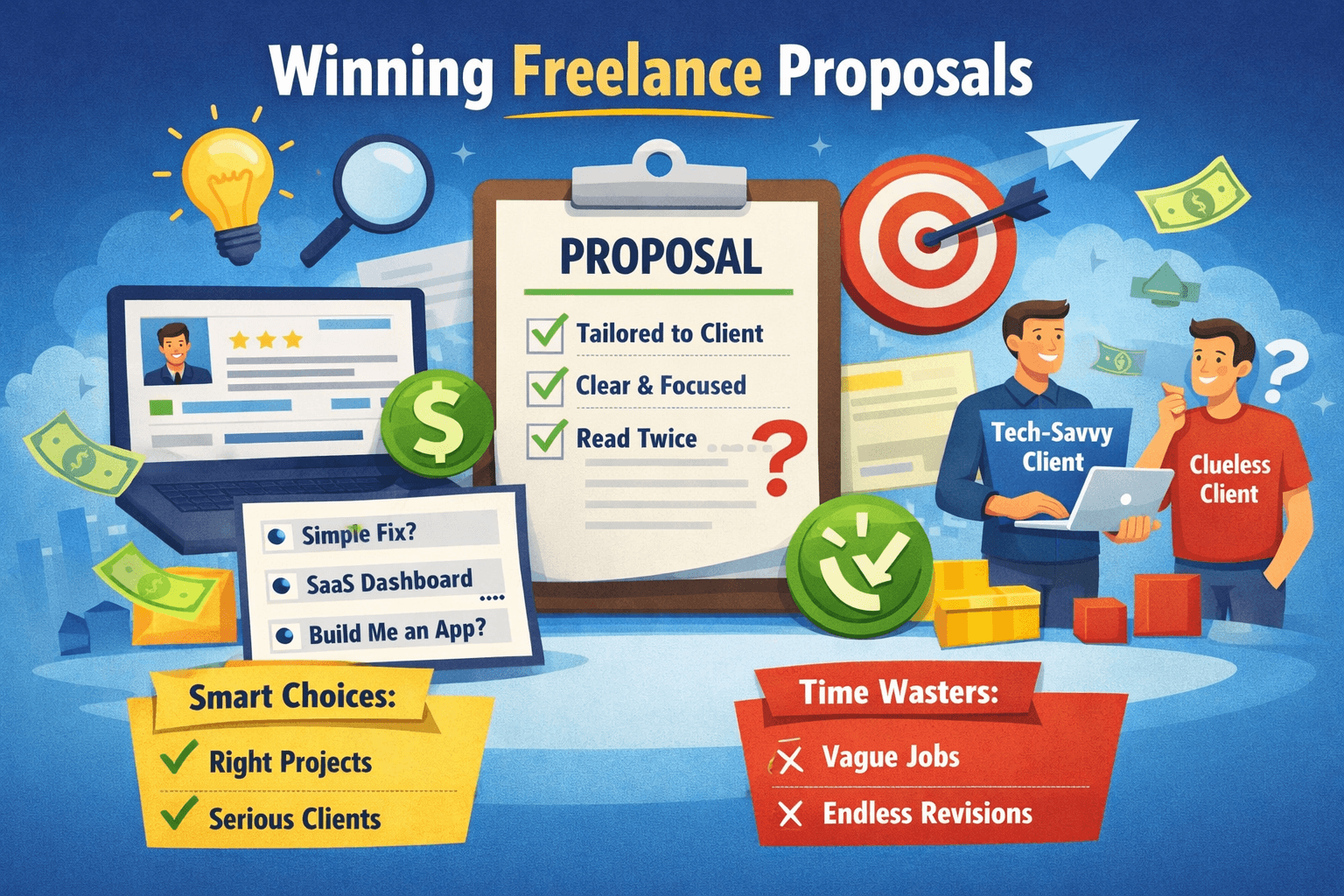
When browsing projects on freelance platforms, success doesn’t start with writing a proposal—it starts with understanding the job post correctly.
There are two critical factors you need to evaluate before applying:
- Your proposal strategy
- Your profile consistency
Your online presence—freelance profile, personal website, LinkedIn—should all tell the same story. Clients often check multiple sources before hiring. If your freelance profile says “backend developer” but your portfolio highlights UI/UX work, applying to frontend-heavy roles creates confusion. Consistency builds trust.
Think Like a Client, Not a Freelancer
Most freelancers focus on whether a project sounds interesting. The better question is:
“What kind of client wrote this?”
You can usually figure that out by reading the job post carefully… and then reading it again.
Let’s walk through four realistic examples.
Example A: “Simple Website Fix” (Undervalued Opportunity)
Title: Fix a few issues on my website Budget: $25 fixed Description: “My site has some bugs and I need someone to fix them. Also want to add a small feature.”
What this tells you:
- The client is non-technical
- “Few issues” is vague—scope is unclear
- Budget is likely just a placeholder
What this really means:
The client doesn’t know how to define the work—not that it’s small.
The opportunity:
- You can scope the real requirements
- You can explain the work in simple terms
- You can reposition this as a larger paid task
👉 Many “small fix” jobs turn into ongoing maintenance contracts.
Example B: “Build SaaS Dashboard” (High-Value, Structured)
Title: Build admin dashboard (React + API integration) Rate: $60–$90/hour Description: Includes Figma designs, API docs, and a 3-week timeline.
What this tells you:
- The client is semi-technical or product-focused
- Requirements are well-prepared
- Design and backend are already defined
Likely scenario:
A startup or product team needs execution—not ideas.
Why this is a strong opportunity:
- Clear scope reduces risk
- You can focus on delivery
- High rates + tight timeline = serious client
👉 These are ideal projects for experienced developers who want efficiency and good pay.
Example C: “API Integration Support” (Technical Collaboration)
Title: Need help integrating payment API (Stripe) Rate: Mid-range hourly Description: “Looking for someone experienced in .NET and APIs to assist our dev team.”
What this tells you:
- The client is technical
- They already have developers
- You’re filling a specific gap
What to expect:
- Clear communication
- Defined tasks
- Less creative freedom
Trade-offs:
- Easier execution
- Lower rates than consulting work
- Potential long-term collaboration
👉 This is great if you like structured work and steady contracts.
Example D: “Build Me an App” (Time Trap)
Title: Create mobile app Budget: $5,000 fixed Description: “I have an idea for an app. Need someone to build it.”
What this tells you:
- The client is non-technical
- No scope, no features, no clarity
- Budget is likely unrealistic
The reality:
- Endless clarification calls
- Constant changes in requirements
- High chance of project failure or burnout
👉 These projects often turn into unpaid consulting sessions.
How to Choose the Right Projects
Once you filter out weak opportunities, focus on projects that:
- Need your specific expertise
- Have clear requirements or direction
- Offer a realistic budget
- Come from clients who seem engaged and serious
The goal isn’t to apply more—it’s to apply smarter.
One Rule You Should Never Break
Never copy-paste proposals.
Every proposal should feel personal and tailored.
Clients can instantly tell when you’re sending generic responses. And if they feel like just another number, you’ve already lost.
A strong proposal:
- Addresses their specific problem
- Uses their language
- Shows you understand their goal
Final Thought
Getting hired isn’t about sending more proposals—it’s about sending the right ones.
When you:
- Choose better projects
- Understand the client behind the post
- And write proposals that speak directly to them
You stand out immediately.
And it all starts with one simple habit:
Read every job post twice.
Use our proposal writer. https://www.bidpilotpro.com